.
The Spanking Gene
Or
The Autistic and the Blade Two
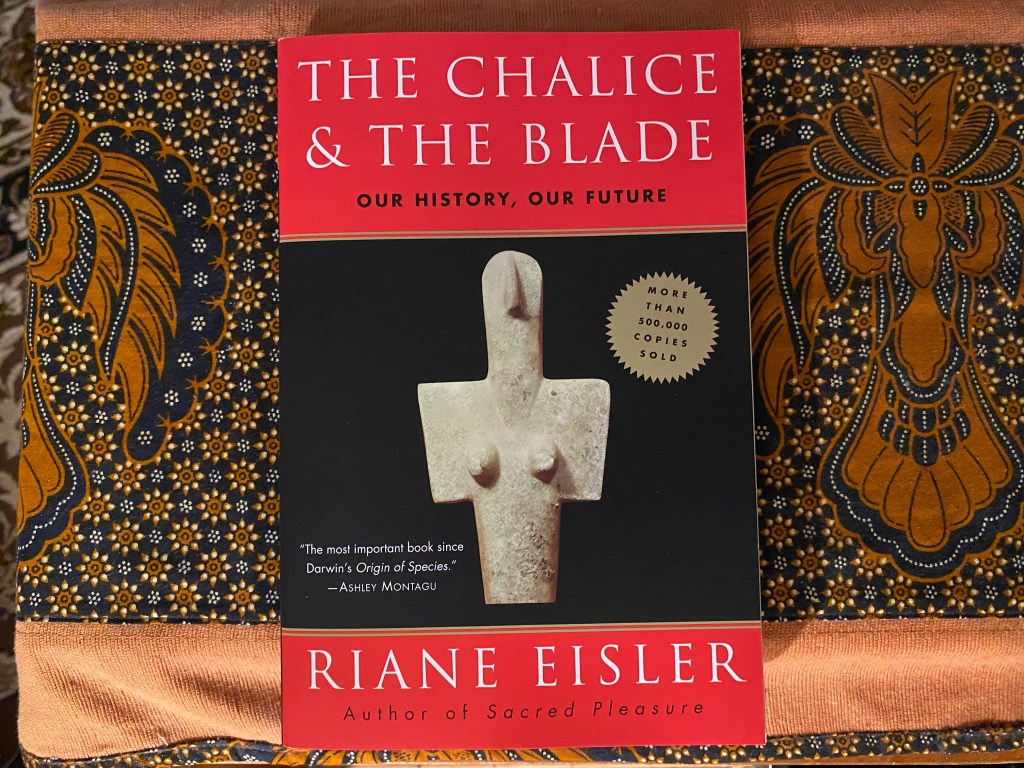
I started here, so it’s the project again, then into the book, Eisler’s project, which was to complete our picture of history and prehistory by including women and female things, and Eisler’s framing, of “Partnership,” and “Dominator,” social models, or paradigms. She takes us into the prehistoric, pre-war world of the Near East and Old Europe and introduces us to the Goddess, the original monotheism. There is theory, theirs and mine. Talk about my Neurotype and Autism generally.
I am going to live-post as I read this great book, The Chalice and the Blade for the second time, at the opposite end of my adult life.
I’m going to read it differently this time, not thinking about Women’s Liberation – that’s almost how long ago, I must have read it nearly new – I mean, not thinking about feminism and the patriarchy, but thinking about spanking and genetics, and about Neurotype this time, about “Spanking, Autism and the Allisty,” to put it in the same format.
If you follow, I’ve been saying that Neurodiversity is almost certainly the correct key to the situation Eisler lays out so well – and maybe I’ll learn they beat me to it, but I read it and missed it the first time, who knows. But that’s the plan, if they haven’t already done so, to turn this history into the history of the rise of the Spanking Gene, to audit it for child abuse and Neurodiversity.
.
Introduction: The Chalice and the Blade
In the first paragraph of the introduction Eisler invites it and welcomes us in to do it: “This book opens a door. The key to unlock it was fashioned by many people and many books, and it will take many more to explore the vast vistas that lie behind it.”
I’m going to take them up on that, big time.
They then describe their family escaping Austria in the nick of time, living for a time in Cuba and ending up in America, and this experience shattered some “local” culture things, showed them the common things across cultures and prompted their lifelong search for just what is so wrong, my words.
Ah, a phrase I love, they say, ” . . .we are quite literally partners in our own evolution.” So they know it’s still happening. Not like some of you Tootsters (Mastodon’s version of tweeting is “tooting,” so “Tootsters,” is Tweetsters). I’ve been honing these arguments online, of course.
Ah, I’d forgotten this language, “we are at an evolutionary crossroads,” politically, meaning, Left or Right, Capitalist or collectivist – but again they say what I maybe got from them, that both sides act the same, suggesting any “crossroads” are behind both of them, and that is not the choice in front of us now.
They say the recent past seems rough, and that we are trying to be less so and that is where we would like to go, but then the project seems to be how to get there, and then we are off and into the heart of the matter, because to know how to get anywhere, first you have to know where you have been, and which direction you are already travelling, so they take us into the past first. My words.
It says what is new is that they plan to address prehistory and female history and build a far more complete picture than patriarchal, or I might say than Allistic science has. Of course I approve. I only want to complete it further and add from the childhood side of life also. One might say there are children of both sexes and without them the picture was only half complete, adults only.
Or perhaps since “children,” is all of us, it perhaps includes us all and misses us all, all at the same time. Not that there is a lot of data regarding children to begin with, no-one said this was going to be easy. Ah, I almost missed it, right at the end of the opening, what I’m here to adjust:
“(The Chalice and the Blade) shows that war and the “war of the sexes,” are neither divinely nor biologically ordained.”
Got to stop you right there. Everything is biologically, not “ordained,” but created. I think there is biology in this story, in the forms of genetics, of neurology and of ongoing evolution. Every story spanning generations needs evolution, and I hope to show that it all makes far more sense, once we consider genetics and Neurotype.
This is always the only thing missing, when all else is good about the Human Sciences, they think they’re “biology free,” somehow – again, like I say far too often: like evolution is only an origin story, like biology is only an origin story.
But I think I can explain that.
The Human Sciences have a way of giving up the entire world of biology to the patriarchy and to the fascists, they feel where biology appears, that humanism loses, automatically or something, just like the bad guys think. The entire stance is, “OK, that’s reality – but wouldn’t THIS be better?,” or something. Everyone believes in some “Human Nature,” which has some aspect of Christian Original Sin in it, and when we get down to it, when push comes to shove, we think Goodness loses.
It’s not true. Biology is life.
Biology is on our side.
This is the point of this project, one of them.
For the record, much of this first argument is simply old, that meme of No Biology Allowed in psychology has gone through many changes, indeed all the way to never mind the whole world of talk, just go straight to medicating for “chemical imbalances.”
This attitude, like humans have transcended their biology and are running on something else, it doesn’t have the sense it had when they were writing this book anymore now, when I formed this opinion. It’s more complex, if I were in a bad mood, I might say it’s insidious. It’s got a lot of biology, modern psychology, in the sense that it usually means a drug prescription, and in the sense that they largely look at us as chimpanzees living vastly out of any natural context it’s all biology, it’s just . . . well, that, I guess. The biology is for chimpanzees, it’s in the past.
I guess I think it is biology but not evolution?
Drugs help, so that’s physical, that’s bioscience, but other than that, nothing about the environment is apparently causative, not since what, the Ice age or something. The function of psychology seems to be helping people adapt their “Paleolithic emotions,” to their modern, unnatural lives, which I intuit as invalidating everything about today and everyone’s emotions right now.
Psychology is somehow only a personal matter, whereas I think the matters it attempts to deal with are the very environmental stressors that drive our evolution and make us what we are. It deals with pain and abuse every day, but thinks our bad feelings are “Paleolithic,” already and it doesn’t think those bad feelings are compounding over time, still active every day like interest, making us ever more . . . something.
Nope, just help another identical human, same old feelings, they haven’t had a new one in a literal age. All this psychology exists in the patriarchy’s world, where it was all created yesterday and everything remains as it was made by it’s warrior god, none of this psychology has the always and forever self-creation of real life and evolution that I assume is natural to every other creature.
Today, they are medicating for the pain of the enshittification, easing the de-evolution, while they sit, smug in the anti-evolution knowledge that is just “Human Nature,” that we abuse one another and nothing really changes. I’m sorry.
Humans have not stopped evolving, evolution is life, it doesn’t stop. War and the “war of the sexes,” is not ordained any way at all, but everything is biologically created, and this situation may require to be biologically . . . addressed and biologically repaired.
Still, this is the project, I shall try to answer in Eisler’s language wherever possible. The basic, possibly Manichean setup of these people and those people, two alternatives, that I’m afraid, is part of the story, even if it’s not enough, as that sort of thing never is enough.
.
Introduction
“Human Possibilities: Two Alternatives”
It begins by telling of common legends of a previous age of gender equality and female wisdom, the Garden of Eden, and a previous time written of in the Tao Te Ching, and in Hesiod and suggests that “legends,” is perhaps less than they really are, that there is archaeology to match these supposed “legends,” now, and I will add that this picture is getting around, it’s what we see in The Dawn of Everything too, and maybe in Debt, the First 5,000 Years, a long, deep prehistory of intellectual growth before we see the stone walls of war.
Next, they make a case that during this long period, the obvious natural and perhaps animistically-related religion was Mother worship, the source of life, kind of thing, and they list Goddess religions and idols from all over. They also makes the case that this has not gone away, that even that vast bastion of the patriarchy, the Catholic Church has room for a Mother of God, had to have, to be relevant, perhaps.
Ah, here they say that when they found sites with predominantly goddess imagery, that today’s men have said that “the women must have been in charge then,” speaking as though of course some gender must have supremacy, that they don’t think equality is a thing or something. It is Eisler’s point, that when the men weren’t in charge, supremacy wasn’t in charge, nobody had to be supreme, and that nobody was in most of our past – and mine that when the Spanking Gene is not in charge, the same thing. Spanking inculcates a need for supremacy, I think.
I will only say that that this rule is a neurology matter, obviously not a genitalia matter, and that during these later, male dominated periods of history, did all women disagree because they are women, or did they mostly go along, because they are normal? I’m saying probably it wasn’t only the men that believed and taught the patriarchy, that no other education was available for anyone.
This is Eisler’s point also, it is a mode of life for all, and that men existed in the more equal past also and shared in that mode of life too. Of course there are women at the front of the regressive social movements today too, standing up for the patriarchy, aren’t there? Of course it’s more than genitalia.
But what is it?
Ah, here’s the stuff I didn’t remember, the technical stuff, terminology.
They say they have a new theory of cultural evolution they call Cultural Transformation theory (oh, whups, you don’t capitalize the “theory,” part, I’ve only had that wrong a million times about mine), where two “models of society” underlie human cultures, the Dominator and Partnership models.
In the Dominator model, it seems, my words, inequality and dominance are normalized, and both a patriarchy and any possible matriarchy would qualify, as long as there’s an imbalance of power.
The Partnership model therefore is the other thing, equality, and running on something besides the inequality, surely the inequality of authority, we assume an equal society runs . . . voluntarily. Voluntarily and consciously. My words, starting with “running.”
So, Eisler says these are social “models,” and I think probably Neurotypes, more like Neurological models, and crudely put, the Partnership and Dominator social models appear to map perfectly onto Neurological stereotypes, Partnership as the God’s Fool sort of Autistic and Dominator as the Neurotypical or Allistic authoritarian sort. In this sense, the term, “Partnership,” appears a little backwards, because Autistic means self oriented and Allistic means group oriented, but only a little because the Greek term is also backwards in a way, in that “the group,” seems to mean the group’s leaders to the Greeks, and group oriented this way is not “partnership,” but authority, at least not to my Autistic brain.
I mean, the words Neurodiversity and Neurotype didn’t exist when this book was written, I don’t think. It’s no great gotcha moment. I had no better idea when I read this book the first time either, it seemed pretty good.
You know, I can see something coming, I think this exercise is going to settle for me a central mystery of human life, which is when did we start “spanking,” that is to say when did we start programming children for the Dominator model and honestly, when you put it like that, the answer was in the question, wasn’t it, it must be the central factor in all of this and so it must have begun when the Dominator model began, meaning a whole lot earlier than anyone dreams.
Ah, and the second major theme of Cultural Transformation theory, the transformation, we used to run on Partnership, and we were on track to keep “culturally evolving,” that way, but we are since something, now running largely on the Dominator model.
They suggest something like the Shock Doctrine perhaps, a disaster, whereupon some opportunistic power hungry men took over, a “cataclysmic cultural event.”
This event was when the Goddess symbols began to be replaced by symbols and ideologies that had shifted focus, a hundred and eighty degrees, they says, from the worship of the Chalice of womanhood and life, to the worship of the Blade of death – and again, this is how I have criticized today’s evo bro biological theorists, this maps, that they seem to think evolution is about who is no longer alive to breed, rather than about the changes living things go through when they don’t die.
The same one hundred and eighty degrees.
.
Introduction
“The Evolutionary Crossroads”
First, I’m doing Eisler some disservice already by arguing, that it’s “not men,” and “not genitalia,” a few times, or I have been doing that in the process of writing, when they never said it was. It’s a little bit of an easy mistake, the point seems to be that the Dominator model includes a supremacy of gender (and of a lot of things), so it often seems a distinction without a difference – but still, I’ve gotten close to putting words in Eisler’s mouth and I apologize for it and pre-emptively, in case I do it again. They begin this section making that very point again, that it’s not something that simply comes with gender but a social model that the whole society follows, men, women, and everyone else, and I agree.
OK, not EVERYONE, that’s one of the points. We are Not All the Same.
They make this “social model,” causative, though, which, always to me has seemed top down thinking, backwards, that the causality works from the bottom up: biology makes what is social, what is socially constructed is not a first cause of any sort but develops from biology somehow or other. It’s not different from what I said above that the Human sciences have learned to treat biology as the enemy of humanist goals, because no answer they produce can defeat the negative “Human Nature,” myth.
They expand on the one-sided theme of the existing science, pointing out that even when the prehistory of women was considered by some few women, that this knowledge was also sort of only, “for women.”
I think I/we are at just that stage now, that I am trying to make science that includes Neurodiversity and Autism in the Story of Humanity – not just, “for Autistics and the Neurodivergent.” I mean, maybe both. I’m not comfortable with the way people talk about Neurodiversity and Autism and evolution now, the Neurodivergent included, they seem to think, as the Antivaxx people do, that we are the new thing in the world, just for good reasons, adaptive reasons, rather than due to poisoning by Tylenol.
I say this as the very model of a medically caused nightmare, I have recently been identified as a Thalidomide baby, and I have medical issues, I do not love the drug companies, but the drug companies have not achieved the level of mastery required to create an Autistic brain. They can cause all manner of brain damage, sure, obviously, but it hasn’t anything to do with Autism.
I’m just like my Dad, and neither Thalidomide nor Tylenol existed in his mother’s day.
My position is that Neurodiversity, and maybe Autism specifically is OG, the original or at least the longstanding version of humankind, and that it is the modern, Allistic who is new in the world and has modern, or more modern “causes,” than Autistics do. This is a major point in this project, that their Cultural Transformation theory is really a Neurotype Transformation theory, a Genetic Drift theory.
(I suppose it’s only a minor point then that the search for an “Autism gene,” is utterly misguided and quite doomed to produce nothing positive with which to balance out any nightmares it creates.)
I think the Dominator’s origin myths are exactly that, the stories of the origin of the Dominator, not the human being, and in these stories, there were already human beings, like how Adam and Eve’s children found wives, because they weren’t the first “people,” only the first of a new type of person.
They say again that the book hopes to make a more complete picture, history and prehistory, complete with women, for everyone – and again, for fullness, I would try to add children to the story, for everyone.
Rather than make the point empirically, they say what might happen if you run a society based this way, on the Dominator model, and say it is not difficult to see what might go wrong. They then sort a lot of civilizations or groups by the Dominator vs Partnership models, making better sense of them than the several ways they describe themselves, Capitalist, Communist, Religious, etc., and I approve heartily. All the Dominator “systems,” are basically the same, but you’d never know it listening to them talk about themselves. They define each other by their small differences, by the shape of the bit of their iceberg that’s sticking out of the water and not by the great identical mass beneath it.
The section ends with them saying that how things might go wrong is very much happening and we need to change our ways, and soon.
It seems I have stolen my entire schtick from Dr. Eisler. The dire warning, the pithy ending. Sorry, and thank you. The pithy ending, I have taken it to new heights (and lows), it’s part of me now and forever, a thing I love too much and fight with always. Ha.
It says the last section of the Introduction is sort of optional, but we’ll have a look.
.
Introduction
“Chaos or Transformation”
Hmm. It says the Cultural Transformation theory traditionally has the pattern of progression we are familiar with, from nomadism to agriculture to cities to industry, and places their idea within or alongside this context, that as that progression plays out, we have choices, Dominator or Partnership models going forward?
Time passes, I think the Davids dispensed with that idea of the order of events that way, or rather summarized for us that the whole field is moving away from it (perhaps an example is that the monumental works of Gobekli Tepe precede any permanent farming community there). A little further on, Eisler does as well, in a way, first they contrast themselves with the traditional sequence by saying it misses the models, and then reminding us that the colloquial meaning of “evolution,” as a progression is not the technical one, and that in evolution proper, regression is also very common.
They don’t dispense with the idea that we want this progression to be true and that it may be, they only caution that it is not a smooth ascent. I’ll go a little farther, as do all evolutionary scientists and say that sometimes it goes the wrong direction altogether and dies out.
After this they go off on what seems a tangent today about books and scientists involved in what did as they predicted turn out to be called Chaos theory. Ah, and stuff about Dynamic Change, my capitals, systems stuff to explain sea changes like the disaster that moved us from Partnership track to the Dominator one – I’m sorry, I just hear Charlie Brown’s teachers when people speak about “systems theory,” with no content, just “systems,” and again – evolution and Neurotype are the dynamics we really need for this puzzle.
There was some inflection point, though, the disaster.
Gould is one of their guys, and I seem to be in the Not-Gould school. It mentions an idea that evolution operates like life in the army, long periods of stable boredom punctuated by times of intense pressure and change. The term, “bifurcation points,” appears.
If you’ve read me before, you know my alarm klaxons are sounding: change, “back then,” but “not now,” this is what I consider the insidious infiltration of creationism that suffuses Allistic evolutionary thinking as regards their own species: evolution only works sometimes. I mean, they want another bifurcation, “now,” but again, “We should try evolution,” isn’t right, is it? Of course we are forever “trying it.”
Blaming Gould, not Eisler, LOL (fist-bump to Bob Trivers, who might enjoy someone accusing Gould of unconscious creationism).
I’m sorry, I couldn’t treat the change and systems theory fairly. You like that sort of thing, get the book. Actually, no, not this book for that, at least not for this bit, it’s only a page, only a bunch of names and hints, really. There is more later.
They end this optional or later section and the whole Introduction with mention of the female knowledge and a list of female scientists and authors, some of whom I’m proud to say I have heard of.
They promise to begin the book proper “thousands of years before recorded history,” which is all well and good, just because we don’t remember doesn’t mean important things didn’t happen, and that they’ll tell us about the disaster – ah, five thousand years ago.
When we all fell into debt too, according to Graeber.
I keep feeling bad about not diving in about the chaos stuff – but they said it was optional, didn’t they. Plus if I would have owed it to anyone then, I don’t think I do anymore, that stuff has stayed in the past, I think.
I mean, I’ll still need a reason why we’re on this road too, why humanity thinks it has to be the way it is, I mean, the Dominator model, to go with their framing, I too need to know why everything is so awful.
(For the record, I’ve said and will continue to, that my “position,” is what I think is the Autistic position, and that it’s rather arbitrary, in the end, I base it all upon nothing better than “what makes sense to me,” – in other words, my own neurology – and this is Even Steven, equal and opposite, because that is what I’m trying to tell everyone, that this is all Allistic science does also, verifies with its own neurology.
What else can any of us do?
In some Star Trek future, we will all bring our various neurotypes to the table and negotiate and plan for some overall best outcomes that are bigger and better than any one our single neurologies could ever devise. The entire human mind. Neurodiversity is a Discovery of the Age sort of a thing, that causes everything to be audited by it, science and philosophy most of all. Or it ought to be. I’m trying.)
Jeff
Aug. 16th., 2024
 The Spanking Gene