The Spanking Gene
or
The Autistic and the Blade Ten
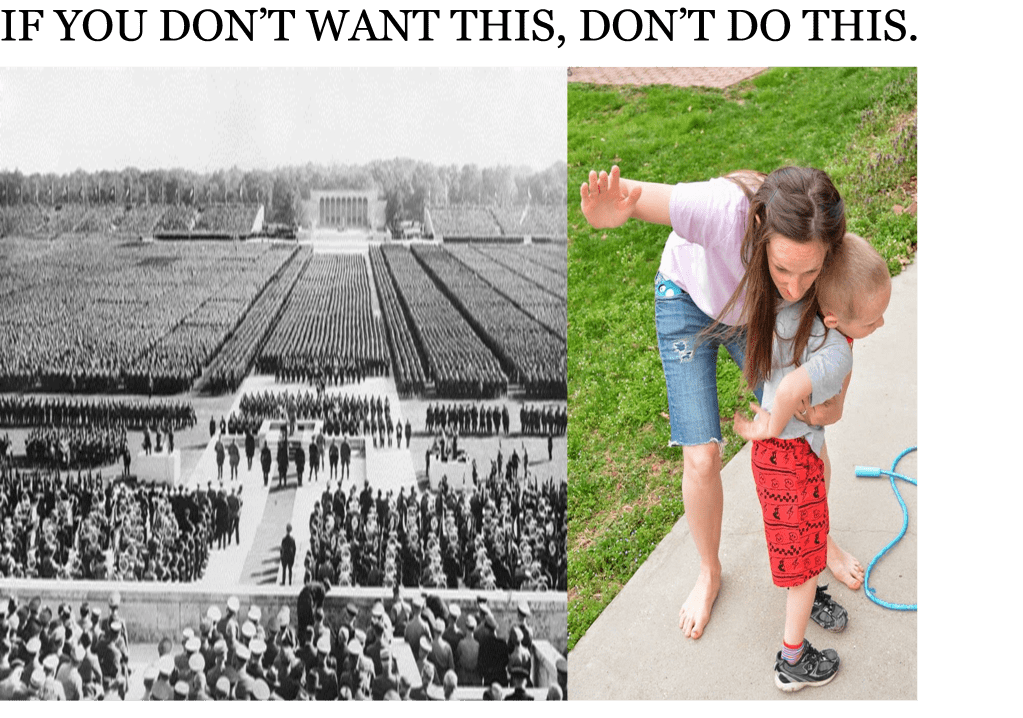
Here Eisler starts again about a social model, about society structuring our relationships and I spend some time trying to turn that upside down and say how our relationships form society instead, and that ours is based in the fundamentally broken relationship between parent and child that is spanking. In terms of history, Eisler shows how much that the modern Dominators credit to Greece for human advancement were really much earlier, old world innovations. I end with some discussion of the philosophers of fascism as simply the exponents and proponents of the Spanking Gene.
The Other Half of History: Part One
I’m remembering as I go, this book was where I got a lot of good ideas I loved, but it’s also where I developed a bad attitude about social science and the existing human sciences in general, that eventually became me deciding it’s because it’s all Allistic and was never drafted for my brain. This passage:
“So successful had the transformation of reality been that this seemingly self-evident fact – that the way a society structures the most fundamental of human relations profoundly affects all aspects of living and thinking – was in time almost totally obscured.”
The whole paragraph is alright and even this whole sentence is alright, it’s all on my side and such, but one of the components is upside down for me, it says it’s “ . . . this seemingly self-evident fact – that the way a society structures the most fundamental of human relationships . . . ” and it always jars me, I suppose it’s a goal to argue with it.
Are we sure we know what “fundamental,” means here?
It is central – and we’re nearly at the page number centre of this book – central to me that society doesn’t structure our most fundamental relationships, that in fact, our most fundamental relationships are what give society its structure. At the risk of being childish and sounding catty, that’s Dominator talk, WE tell YOU how to “structure your most fundamental relationships.” I don’t think that science would fly in a Partnership world, and it does not with me.
Spanking is the main, “fundamental relationship,” and it’s what structures Dominator society, not the other way about. You don’t beat your own children on somebody else’s say so, you got to have your own reasons. Not that they don’t say so – but most people eventually do find their own reasons, don’t they. Ha – it’s “just a theory,” and their parents were wrong to do it to them, until they find their own reasons, until this kid can be hurt and cry, we’re sorry, but we have to go to work, don’t we?
Ouch. I’m too much for myself too, sometimes.
But yes, same reasons, the model is sort of toxic, just things flow in the other direction and make more sense this way, with the creature’s brain or childhood providing the model, not macrosocial circumstances – and same result too. We didn’t have the words for Neurotype, and I still like “Dominator,” and “Partnership,” alright, I just think they’re adjectives for people, not social models.
Ah, they define the two by how the main two genders are defined under each paradigm, and again, man and woman are not the first fundamental relationship, except perhaps ostensibly in Dominator mode, in Partnership mode, it was mother and child, remember?
Spanking first, I’m stuck on it. And perhaps unconsciously, but Dominator society agrees, and spanking is its first, most important fundamental relationship. They never bring it up, they do not speak of it, it is never mentioned in books, except books about how to do it, because it is never up for debate. It is not in psychology books, because Allistic psychology is not concerned with what is the same for everyone and only documents strangeness, weird extreme examples of child abuse are the only ones to qualify, part of the “how to,” function, how not to, how much is too much.
To the Allistic, Dominator mind, spanking is fundamental and mission critical. So I am not going to be able to focus on these new terms they’re introducing, androcracy and gylany, that’s not it, it’s genes, Neurotype, and spanking, not only the neurological differences between Allistic men and Allistic women.
Third time I’ve said, I am sorry, but that is my theme, spanking and the brains it nurtures.
This seems obvious, and it may be today to everyone, Eisler included, I can’t say. There is a thirty year anniversary epilogue, and I’m making a point of not reading it first, of working through the original myself first. I suspect there may be passing mention of Neurotype, but I refuse to check, Id rather work through it and eat my hat later, if need be. I am organizing my own thoughts by doing all of this.
.
Chapter Eight
The Other Half of History: Part One
“Our Hidden Heritage”
Ah, some of the same talk I make today, about how the Dominator calls itself the first, that the pagan Greeks called the monotheism new and strange, when the Goddess used to rule forever, this parallels my Neurodiversity structure, where the Allistic Autism parents call Autism a new broken thing, when I think the whole world was “Autistic,” forever and the new thing is Allistics, like since what did I say, a mere seven to ten thousand years ago, a blip.
This section makes the point that much of what gets credited to Greek or Mesopotamian civilizational advances during this period – early Greece – were really simply the persistence of the previous Neolithic cultures, and that Partnership cultures haven’t really gone away, but they have been assimilated and their symbols and goddesses reduced to a secondary status.
.
The Other Half of History: Part One
“The Cyclic Unity of Nature and the Harmony of the Spheres”
In this section, Eisler makes direct connections from the Old society to the Greeks, saying that many of the most famous men of the early Greek flowering learned from women, in old institutions, and what was “new,” to the Dominators around and before them really wasn’t.
The lovely phrases in this section’s title clearly echo the Goddess’ world, and there were still some famous and important women for a time, the priestesses of the oracles and such, but the androcracy was established and this would fade.
About the Greek “firsts,” they used “Pythagoras’” theorem to build the bloody ziggurats and whatnot long before him (from today’s news, not the book), his teacher was a woman named Themistoclea; Socrates had a woman teacher named Diotema, these women were priestesses from old traditions.
I think I’m arguing when I should be doing something different, reinterpreting, it’s not right and wrong that way, no-one is responding to moral lessons, it’s Neurotype, it’s all “right,” to some sorts and wrong to others. We need the conversation to move up a level, where we can . . . no, that’s NOT it.
I need to not solve it in every sentence. I’m not here to solve the problem, only here to name it, just say, “Can’t think outside of hierarchy? That’s the Spanking Gene.” Not right or wrong, or Here’s what you SHOULD think, or No, here’s what “I” feel in MY bones – just name it: that’s an Allistic thought, appropriate perhaps for the warrior caste, perhaps.
Maybe that’s still too much. I’m just trying to say that the androcracy is the Spanking Gene, not a social system, but a Neurotype, an animal that really is different between the ears than its predecessors, that it isn’t a matter of talk and reason, but of environment and evolution, of the environments that create the minds we are trying to reason with. Genes and Neurotype make better sense of the Dominator situation than a “social model,” does, mostly because we have discovered this subtype of human being and everyone therefore falls into one subtype or the other, it exists and must be accounted for.
Spanking, same, it also exists and must be accounted for. Social models that do not account for subtypes and environment or genes are very much, “just a theory,” to me.
That’s meta, I suppose, and things start to look exponentially more difficult, but it’s the reality. Spanking is not a “virtual,” thing, the possibility of violence is not a virtual thing and it means all sorts of real, physiological things, the virtual part really means real physiology, so imagine what it means when you follow through. Spanking is the environment that grows Allistic minds.
There is a gene (colloquial use, many genes, alleles, all included) for spanking, maybe for Allism and abuse grows it, this seems not mysterious at all to my neurology. Since the Neolithic collapse where it isn’t outright war and chaos, it is law and order and spanking, all must feel the threat, all must grow the gene. They are sure it’s in everyone, and also in Autistic children somewhere but that it needs more extreme methods to bring it out. There is a reason for their faith in violence, it never does nothing, it always makes something happen, it always tweaks the gene, grows the gene, causes a little more evolution towards violence, growing their type, and their society.
I mean, if it doesn’t make the Autistic kid more normal, it makes the practitioner torturing the kid more . . . something, some professional version of “strong.” “Professional,” I guess.
To a Partnership mind, it may not seem to solve many things on the surface, but abuse creates a consensus, makes them all the same, not an endorsement, just an explanation. Allism’s violence is irresistible, so that’s called genetic drift, unchecked, it will get us all. And arguing with it like it’s a “social model,” that’s not really checking it, is my point, especially if they’re all still spanking, is the point, the dare I say, the revolutionary point of this project.
Chapter Eight ends with the later Greek philosopher’s describing their mindset, and it’s basically fascism, power wins, if you can, you may, power sits in the place I think morality ought to, it is word for word what they still say today, power is the organizing principle, and this is the gene, this is Allism, because my neurology does not see this as “organization,” and neither does the world and it’s operation, like the climate. This only exists in one place, this “organization,” between Allistic ears. That’s Neurotype, nothing else.
These philosophers, they plumb their souls, they reach into their minds to give us what they find in there, what they find to be . . . basic, fundamental to their minds, to their neurology – as I do, I have always felt this need, and it has put me at odds with them all, Nietzsche, he plumbed himself and found that power stuff, my man found Allism at his core, is all, just his own sort of mind, nothing bloody universal – except drift, it bloody will be, true or not, sort of thing.
These modern ones, same, Jordan Peterson, simply looking inside and describing the nightmares within his bitter, spanked brain.
Not believing in evolution, I mean, it’s like the one about not believing in science, science doesn’t care what you believe, science believes in you, evolution believes in you, and living and being active in life while not “believing” in it is like driving your car while not “believing,” in driving, like you think it’s just the car’s Nature to want to stay on the road or something. Doesn’t matter what you do with that steering wheel thingy.
I trust, that if you don’t believe in driving that you then don’t drive, right? Neurotype is weird, it seems impossible, but there it is anyway, it believes in you.
There were two more sections:
“Ancient Greece” and “Androcratic Right and Wrong.”
Jeff
Aug. 16th., 2024
 The Spanking Gene